


The rule of thumb is simple. 10mm at the first lobe, 8mm above it, 6mm at the top.
That works for a lot of ears, but not all of them. This guide covers the right size for every placement, how to measure your own ear, and the sizing mistake that catches most people out.
The Quick Answer
These are the sizes that work for most people in each placement. Adjust from here based on your own ear.
| Placement | Diameter | Best styles |
|---|---|---|
| First lobe | 10mm | Hoops, huggies, drops, studs |
| Second lobe | 8mm | Huggies, small hoops, studs |
| Third lobe | 6 to 8mm | Small huggies, studs |
| Helix | 8mm | Small hoops, flatback studs |
| Forward helix | 6 to 8mm | Flatback studs, tiny hoops |
| Tragus | 6 to 8mm | Flatback studs, tiny hoops |
| Conch | 8 to 10mm | Studs, small hoops, cuffs |
| Flat | 6 to 8mm | Flatback studs |
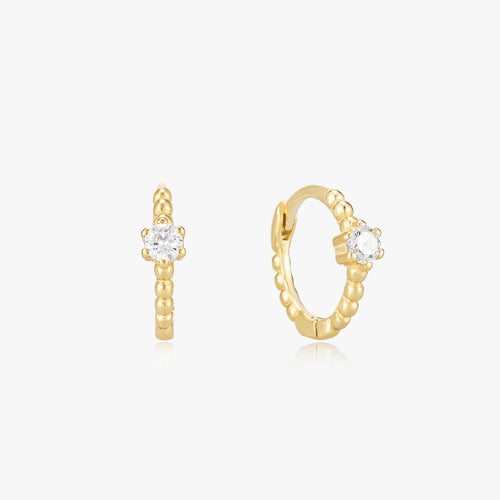
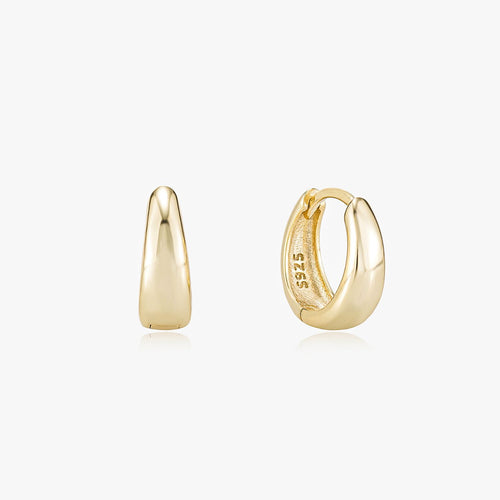
Shop huggie earrings

The Graduation Rule
The single most useful principle in stack sizing: go smaller as you go higher.
A 10mm at the first lobe, an 8mm above it, a 6mm at the top. Each step down is small enough to feel natural and large enough to be visible.
There are two reasons this works. The first is anatomical, because the ear genuinely narrows as you move up. The second is visual. If every piece in your stack is the same size, the eye has nowhere to land and the whole thing reads as flat, even when the individual earrings are lovely.
Two millimetres is the right increment. One is too subtle to notice. Three starts to look disconnected. Explore our ear stacking guide for more inspiration to build a curated look.

Inner Diameter vs Outer Diameter
This is the most common reason an earring arrives the wrong size.
Inner diameter is the space inside the hoop, which is where your lobe actually sits. Outer diameter measures the whole earring including the metal itself, so it is always the larger number.
The difference is usually 2 to 3mm. A hoop listed as 12mm outer diameter is roughly a 9 or 10mm inner diameter. If you order by the wrong measurement, you will be off by a full size.
Most quality brands list inner diameter, but not all say so. If a listing does not specify, it is worth asking before you buy. At LYANG & CO. our measurements are inner diameter.

A Note on Cartilage
One rule worth keeping regardless of style preference. Do not put a hoop larger than 12mm in a cartilage piercing.
Cartilage is less forgiving than lobe tissue, and the extra weight and leverage of a large hoop can cause the piercing to migrate over time. For helix, tragus, conch and flat placements, stay in the 6 to 10mm range and keep the pieces light.
How to Measure Your Own Ear
Two minutes with a ruler will tell you more than any chart.
-
Hold a ruler against your earlobe with one end at your piercing hole
-
Measure down to the bottom edge of your lobe
-
Most people measure between 5 and 8mm
-
Add 2mm for a close, hugging fit
-
Add 3 to 4mm if you want a little visible gap

So if you measure 6mm from your piercing to the edge of your lobe, an 8mm huggie will sit snugly and a 10mm will have some movement. Both are correct. It depends which look you want.
If you have thicker lobes, size up by 2mm from the chart. A hoop should feel secure when it closes, never pinched.
Your Piercing Spacing Sets Your Maximum Size
Here is the part that only matters when you are stacking, and almost nobody mentions it.
Your piercings are usually spaced 5 to 7mm apart. If you put a 10mm hoop in your first lobe and your second piercing sits 5mm above it, that hoop will physically overlap the earring above.
The result is two pieces competing for the same space, and a stack that looks crowded no matter how nice the earrings are.
-
Piercings 5mm apart: keep the lower hoop at 8mm or use studs and flatbacks
-
Piercings 6 to 7mm apart: a 10mm at the lobe works comfortably
-
Piercings 8mm or more apart: you have room for a larger hoop or a drop
If you are still planning your placements, our ear piercing chart covers every piercing type and where it sits on the ear.
Stud Sizes for Stacking
Hoops get all the sizing attention, but most stacks are hoops and studs together.

-
2 to 4mm: tiny. Ideal for second and third lobes, and for cartilage placements where you want sparkle without bulk.
-
5 to 6mm: the classic everyday size. Works well as an anchor at the first lobe.
-
7mm and above: a statement stud. Best worn alone in a placement, with quiet pieces around it.
The same graduation logic applies. A 5mm stud at the lobe with 3mm studs above it will look considered. Three 5mm studs in a row will not. Browse stud earrings to see the range.
What About Gauge?
Gauge is the thickness of the post that passes through your piercing, and it is a different measurement again from diameter.
The scale runs backwards. A higher number means a thinner post.
-
20G is 0.8mm. The most common gauge overall. Standard for butterfly-back studs, and for lobes pierced with a gun at a mall or jewellery store.
-
18G is 1.0mm. Common for lobes pierced with a needle at a professional studio, and for many huggies and flatback earrings.
-
16G is 1.2mm. The standard for cartilage placements such as helix, tragus and conch, where a thicker post gives the piercing more stability. Some studios now use it for lobes as well.

Here is the part that matters when you buy. A thicker post will not fit a thinner piercing. If your lobes were pierced with a gun, they are most likely 20G or 18G, and a 16G earring will not go in. Do not force it. If you are unsure of your gauge, a piercer can measure it in about thirty seconds.
Our flatback earrings come in both 18G and 16G, with posts in 6mm or 8mm lengths.
Frequently Asked Questions
What size huggie should I get for my first lobe?
10mm suits most people. If you have thicker lobes, go to 12mm. If your lobes are small or thin, 8mm will sit better. Measuring from your piercing to the bottom edge of your lobe and adding 2 to 4mm gives you the most accurate answer. Check out our full huggie size guide.
What size earrings should I use for stacking?
Graduate downward as you move up the ear. A common pattern is 10mm at the first lobe, 8mm at the second, and 6mm at the third or in cartilage. Two millimetres between sizes is the right increment.
Is 8mm small for a hoop?
It is small, but that is the point. An 8mm hoop sits close to the ear and reads as a huggie rather than a hoop. It is a very good size for a second lobe piercing or for a helix. For a first lobe, 10mm usually looks more proportional.
What is the difference between inner and outer diameter?
Inner diameter is the space inside the hoop where your lobe sits. Outer diameter includes the metal itself, so it is 2 to 3mm larger. A 12mm outer diameter hoop is roughly a 9 to 10mm inner. Always check which measurement a brand is using.
How do I measure my ear for huggie earrings?
Hold a ruler at your piercing hole and measure to the bottom edge of your lobe. Most people measure 5 to 8mm. Add 2mm for a snug fit or 3 to 4mm for a looser one, and that is your ideal inner diameter.
Can I wear a large hoop in a cartilage piercing?
Stay under 12mm. Cartilage does not tolerate weight the way lobe tissue does, and a large hoop can cause the piercing to migrate over time. For helix, tragus and conch placements, 6 to 10mm is the safe range.
What gauge are LYANG & CO. earrings?
Our flatback earrings are available in both 18G (1.0mm) and 16G (1.2mm), with post lengths of 6mm or 8mm. If you are unsure which fits your piercing, a piercer can measure your gauge in about thirty seconds.


