


Three things make an ear stack look considered rather than crowded. Anchor at the lobe. Graduate the sizes upward. Contrast the shapes.
Below are specific combinations for 2, 3 and 4 piercings, all built on those three rules.
Shop earring stacks and sets
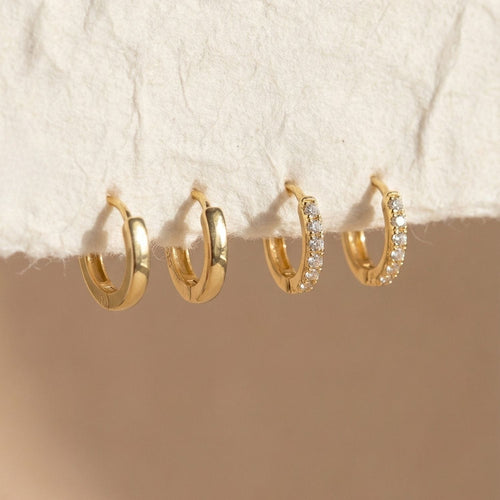 Everyday Essential Huggie Earring Stack Gold
$99.00
Everyday Essential Huggie Earring Stack Gold
$99.00
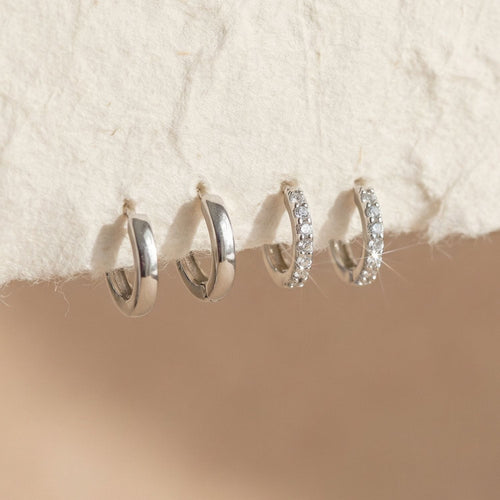 Everyday Essential Huggie Earring Stack Silver
$99.00
Everyday Essential Huggie Earring Stack Silver
$99.00
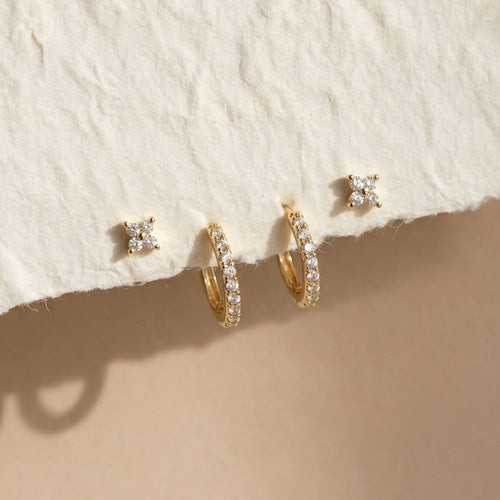 Essential Sparkle Earring Stack Gold
$91.00
Essential Sparkle Earring Stack Gold
$91.00
Three Principles Behind Every Good Stack
Every combination below follows the same three rules. Learn them once and you can build your own.
Anchor at the lobe
Your first lobe piercing carries the visual weight. It is the largest piece and the one everything else is built around. Choose it first.
Graduate the scale upward
Sizes get smaller as you move up the ear. A 10mm hoop at the lobe, an 8mm above it, a 6mm at the top. This follows the natural shape of your ear and stops the stack looking top-heavy. Our guide to earring sizes for stacking breaks down what each measurement actually looks like on an ear.
Contrast shape, not just size
Two identical pieces in different sizes still read flat. Mix a hoop with a stud, or a smooth piece with a textured one. The contrast is what makes a stack look styled rather than uniform.
One more rule of thumb worth knowing. Aim for roughly one statement piece to every two quiet ones. With three piercings that means one hoop and two small studs. It keeps the stack interesting without letting it shout.
Ear Stack Ideas for 2 Piercings
Two piercings is the most versatile starting point, and the most commonly underestimated. The mistake people make is treating both piercings as equal. They are not. One leads and one supports.

The everyday stack
-
First lobe: a small gold huggie
-
Second lobe: a plain or CZ stud
The most wearable combination there is. Works with anything, suits every face, and takes no thought in the morning. Start here if you are unsure. Browse huggie earrings and stud earrings.
The graduated hoop stack
-
First lobe: a 10mm hoop
-
Second lobe: an 8mm hoop
Same shape, stepped down in size. Clean and slightly more deliberate than the everyday stack. Keeping both in the same metal makes the repetition read as intentional, though mixing gold and silver works just as well if you would rather.
Lobe and helix
-
First lobe: a drop earring or larger hoop
-
Helix: a small flatback stud
If your second piercing is cartilage rather than lobe, let the lobe do all the work and keep the helix tiny. A flatback earring or ballback earring has a smooth back that will not catch on your hair.
Ear Stack Ideas for 3 Piercings
Three is where a stack starts to look curated. It is also where the graduation principle earns its keep, because you now have enough pieces for the scale to be visible.

Three lobes, graduated
-
First lobe: a chunkier hoop or drop
-
Second lobe: a small huggie
-
Third lobe: a tiny stud
The cleanest three-piercing stack. Weight at the bottom, quiet at the top. This is the combination that suits the widest range of outfits and occasions.
Two lobes and one helix
-
First lobe: a medium hoop
-
Second lobe: a stud
-
Helix: a small flatback or tiny hoop
Adds height to the ear without much commitment. The helix piece should be the smallest thing you own. See our helix earrings for options.
The mixed-texture stack
-
First lobe: a smooth polished hoop
-
Second lobe: a textured or twisted huggie
-
Third lobe: a CZ or pearl stud
Same sizes as the graduated stack, but the interest comes from surface rather than scale. A good option if you like your pieces to feel considered up close.
Ear Stack Ideas for 4 Piercings
Four is where planning starts to matter. You have enough pieces that a bad combination looks cluttered rather than curated, and if any of them are cartilage, materials matter more too.

Four lobes, and whether your ear fits them
Worth checking before you plan this one. Most adult earlobes are 15 to 20mm tall, and safe spacing between piercings is 5 to 7mm. That means four lobe piercings need a larger than average lobe, and precise placement.
-
First lobe: a statement hoop or drop
-
Second lobe: a medium huggie
-
Third lobe: a small huggie
-
Fourth lobe: a tiny stud
A steady step down in four stages.
Two lobes and two cartilage
-
First lobe: a hoop or drop
-
Second lobe: a stud
-
Helix: a small flatback
-
Conch or flat: a small stud or huggie
The most balanced four-piercing setup, and the one that reads most clearly as a curated ear. Spreading the pieces across the whole ear stops everything bunching at the lobe.
For cartilage placements, titanium is the safest choice. It is nickel-free, very light, and the metal professional piercers use. Once a cartilage piercing is fully healed, quality 925 sterling silver works well too and gives you more to choose from. Explore our hypoallergenic earrings for options.
The full curated ear
-
First lobe: a statement drop or chunky hoop
-
Second lobe: a graduated huggie
-
Helix: a tiny flatback stud
-
Outer rim: an ear cuff, no piercing needed
The cuff is the piece most people forget. It adds height and dimension with nothing passing through your skin, which makes it the easiest way to fill out an ear. See our ear cuffs.
Should Both Ears Match?
No, and matching ears now look slightly dated.
The approach that works is contrast with intent. If one ear is heavily stacked, keep the other cleaner. A single hoop or a pair of studs on the quieter side is enough.
The one rule worth keeping: each ear should still look finished on its own. Being restrained is good. Unfinished is not. If the quiet ear looks like you forgot to put an earring in, add one small piece.
How Many Piercings Will Actually Fit?
Worth knowing before you plan a stack around piercings you do not have yet.
-
Most adult earlobes are 15 to 20mm tall
-
Safe spacing between piercings is 5 to 7mm
-
The minimum is 4mm. Any closer and healing piercings can irritate each other
-
Two lobe piercings fit almost every ear. Three fit most. Four need a larger lobe
A good piercer will assess your lobe and mark the placements before committing. If you are adding piercings to build toward a stack, our ear piercing chart covers healing times for every placement.

Before You Buy
-
Weight matters more than number. Four light pieces are more comfortable than two heavy ones. Heavy earrings pull on a piercing and cause irritation that has nothing to do with allergy.
-
Cartilage needs titanium while healing. Titanium is nickel-free and biocompatible, and it is what piercers use for new piercings. Once fully healed, solid gold and quality 925 sterling silver is a good option too.
-
Check the post, not the front. The decorative front is not what goes through your ear.
-
Build one piece at a time. If something irritates you, you know exactly which piece caused it.
If your ears are sensitive, choosing hypoallergenic materials is important to keep your piercings comfortable over time. And if you want to know what to avoid before you start styling, read our guide on ear stacking mistakes to avoid.
Frequently Asked Questions
What is the best ear stack for 2 piercings?
A small huggie in the first lobe with a stud above it. It is the most versatile combination, works with almost any outfit, and needs no thought in the morning. The key is letting one piece lead rather than treating both piercings equally.
How do I style 3 piercings?
Graduate the sizes. Largest at the first lobe, smaller in the second, smallest at the top. Aim for one statement piece and two quieter ones. Mixing shape as well as size, such as a hoop with two studs, gives a more styled result than three of the same thing.
What earrings work best for 4 piercings?
Spread the pieces across the ear rather than clustering them at the lobe. Two lobe piercings plus a helix and a conch or flat placement gives the most balanced look. Keep everything above the lobe small. For cartilage, choose titanium while healing, and either titanium or quality sterling silver once healed.
Should my ear stacks match on both ears?
No. Asymmetric stacks are the current approach and generally look more considered. If one ear is heavily stacked, keep the other simpler. Just make sure the quieter ear still looks finished rather than empty.
How many earrings can I stack at once?
Physically, most ears fit two to three lobe piercings comfortably, with more available across the cartilage. Practically, weight matters more than number. Several light pieces are easier to wear all day than a few heavy ones.
What size earrings should I use for stacking?
Step down as you go up. A 10mm hoop at the first lobe, 8mm at the second, 6mm at the third is a reliable pattern. For cartilage, smaller again. Matching sizes across placements is the most common thing that makes a stack look flat. Our earring sizes for stacking guide shows what each size looks like in place.
Can I build an ear stack with sensitive ears?
Yes. Choose titanium for cartilage that is still healing, and quality nickel-free materials such as titanium or 925 sterling silver throughout once everything is healed. Add one piece at a time so you can identify anything that irritates. Our hypoallergenic earrings are designed for exactly this.
Ready to build yours? Try the ear stack builder to build your own, or browse earring stacks for ready-made combinations.


